Why the mid-life crisis and how to deal with it?
Before I discuss with you about today’s topic, I would like to quickly share some news. A person had gotten in touch with me after reading my blog on ‘self esteem issues’ to discuss her personal (similar) issues. After hearing everything she had to say and her answering some other questions that I had followed up with, I suggested some changes to be made to her way of thinking and some bold choices she had to make to overcome these self esteem issues. As she really wanted to overcome them and improve, she sincerely did everything that was suggested to her and now her self esteem levels are completely different to what they were months ago.
Also, the self esteem issues she had were heavily affecting her work-life and how she communicated with her colleagues and Boss. Now with this change in her self-esteem levels, the way she comes across to her colleagues and boss is diametrically different to what it was before and she is being taken way more seriously by them. Day before yesterday, she informed me that she has been given more leadership related responsibilities at her workplace now and is probably also lined up for a promotion in her company’s next line of appraisals. This was not surprising to me at all because her merit levels are in no way proportional to the position she was in. It was indeed her self esteem issues which were actually stagnating her growth a lot. But still this news made me very happy as well, as my purpose behind blogging is being served. Because if not for the blog that she had read that day she would have probably continued to think that her colleagues and Boss are just ‘khadoos’ people and not realized the underlying self esteem issues which were affecting her worklife.
Now, onto the social anxiety topic
To some extent almost all psychological or rather psychiatric illnesses, restrict us from living our lives to the fullest. But, what I wish to discuss today with you is, that particular psychiatric illness which to an untrained eye would probably just look like a deficit in soft skills but is so much more than just that. It plays a significant role in allowing us to exploit our potentialities to the fullest. It wouldn’t be an overstatement to say that this problem if corrected can make us lead a successful life instead of a mediocre one.
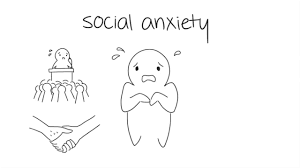
To set the tone of what broadly ‘Social Anxiety’ looks and feels like, I shall illustrate some situations.
- With his heart-pounding, Vishal enters into the auditorium and sits in the seat allotted to him. It is the dreaded day on which Vishal is scheduled to present to an audience of 500 odd people. When Vishal’s name is announced, he starts sweating profusely. With shivering hands, he takes the microphone into his hands. His mouth gets dried up and he started feeling dizzy. He fails to utter a single word and has to get down the stage feeling insulted. This is the same result that comes out every time Vishal has to present on a stage.
- A function hall is lit up with colorful and bright lights for the grand celebration of an engagement ceremony. Radha, who is dressed up in a silk lehenga and grand jewelry, is anxiously waiting for her turn to greet the engaged couple on stage. She had sat in a corner seat avoiding all her relatives until then paying no heed to their repeated requests to come join them. But when Radha tries to go further ahead in the line that she is standing in, she fails to even put one step forward. The thought that she will be seen and observed by many people when she is on the stage is making her tremble with fear. When eventually, her turn did come, Radha went on to the stage, greeted the couple and hurriedly left for her home as if someone is chasing her
As you would have figured out by now, Vishal and Radha, both are the typical examples of an anxiety disorder which we call as ‘Social Anxiety Disorder,’ which is generally also called as ‘Social Phobia.’ This psychiatric illness is one of the most devastating illnesses of psychiatry like major depression and substance abuse.
An important word of caution – Social Anxiety Disorder is not to be confused with shyness to perform, anxiety before meeting new people, examination related anxiety and tense feeling when going on a date for the first time or giving an interview. A simple trick to differentiate between the aforementioned type anxieties and Social Anxiety Disorder would be, the act of trying to avoid rather than attempt. Because, in all those occasions a person learns how to combat that anxiety eventually and attempts the activity. But in the case of Social Anxiety Disorder, the anxiety is pervasive and intense to a level that the person prefers to avoid the activity rather than attempt.
Social anxiety disorder is characterized by the extreme levels of anxiety, nervousness, which is experienced by the person whenever they expose or have to expose to social gatherings or perform something on stage. This acute level of nervousness is because of the overwhelming fear of being judged, embarrassed, watched or humiliated by the people around. This fear is so intense that it interferes with their work, studies or any other activities. Owing to fears of being ridiculed or humiliated they avoid all those occasions where they have to appear in public and perform. Most of the times, the people suffering with this social phobia, worry days and weeks ahead of the dreaded activity. Simple activities like writing a small line in front of other people and using a crowded public restroom could also make that person tremble with fear.
Social phobia is a major concern to the society mainly for two reasons. One is, it has high rate of co-morbidity with major psychiatric illnesses like Depression and Substance Abuse. Second being, society is also hugely at loss as many young people are affected by this disorder and their talents and merits are so not utilized.
Social phobia usually begins in early adolescence. If this disorder is left untreated, it will leave many people unemployed or stuck in some mediocre jobs though they deserve better jobs. It limits their personal growth to a minimal level as they do not want to expose to larger domain of merit by relocating. Some people with this disorder also might prefer to just not marry because of the fear of failing in interpersonal relationships.Based on some researches, causes for Social Anxiety Disorder are as follows,
- Neurobiological factors: Some studies have proven that social phobia is inherited.
- Psychosocial factors:
- The development of social phobia can be influenced by the parent child interactions within a family where any of their parents is suffering with panic disorder or major depression. Reason for the development of social phobia in children of these parents can be explained. The children may acquire certain attitudes and behaviors from their depressed or panic parents which makes them more susceptible to develop social phobia.
- Over protective parents, emotionally unsupportive parents and parents who are over concerned with grooming, appearance or manners and parents who discourage children from socializing will also influence the development of social anxiety disorder in children.
- Less income and less education also acts as contributing factors to development of social phobia.
So far as the sufferings of a person with Social Anxiety Disorder is concerned, psychologically, the patient may experience heightened level of sensitivity towards criticism, rejection or negative evaluations. Besides psychological suffering patient experiences many physical complaints, whose origin is again the acute anxiety and intense fear. Physical symptoms like increased heart rate, dry mouth, giddiness, profuse sweating, unsteady gait, shivering of body and diarrhea are commonly observed in people with Social Phobia.
Though occurrence of this disorder is equal in both genders, it has been observed that men are more likely to seek treatment than women for this.
We should not be careless when this phobia becomes a pervasive one and starts affecting our day to day activities. Mental health professionals like a Counselling Psychologist/Clinical Psychologist/Psychiatrist only can diagnose and treat this illness appropriately. Social phobia without treatment becomes a chronic life-long condition with very little hope of recovery. But if treated at the correct time it will yield extremely good results.

Usually medication with anxiolytics is useful but I have come to observe in my experience that Behavioral Therapy strategies like relaxation exercises, desensitization techniques and many techniques of Cognitive Behavioral Therapy, conducted by a therapist can cure the condition as well.
A simple self-help strategy that you can implement to combat this illness is that you should never avoid attempting the dreaded activity as avoidance makes the condition more severe. But after attempting to do this, if you are failing to succeed then it is an indication that you need professional help and you should definitely do it without any excuses.
The above mentioned points are all general in nature but if you need personalized strategies with regards to dealing with this phobia, based on the situations and people involved in your life, then you can reach out to me via email on drkavithanarayandas@gmail.com. Always happy to help.
Stay mentally healthy always 🙂